
Doing new stuff is scary. Particularly if the risk involved can lead to a life threatening situation as is the case with swimming.
Having taught swimming for over 15 years I have seen a whole lot of people (of all ages) show up at the pool for their first lessons completely terrified and hesitant to even dip their toes in. And I am here to tell you that there is nothing wrong with being afraid to do something.
But that does not mean that you should not do it.
Many of the most amazing things we will experience in life are terrifying the first time that we do them. Roller coasters, asking someone out on a date, driving, etc… But when we can move past the initial fear and go for it, those scary things lead us to the most fun and enriching experiences life has to offer.
So if swimming is scary for you, I get it. But show up anyway. Because conquering this anxiety and proving to yourself that you are capable of overcoming your fears at the pool will create in you the ability to conquer fears in every other aspect of your life.
See, swimming is an important life skill, and yes, it offers the opportunity to experience a ton of exciting and fun things, but it is also a way for you to discover that you are capable of doing hard stuff. And that taking the first step in anything that you are learning to do is always the toughest part.
Do hard stuff and it gets easier. If you never try, you’ll never know…
The health and fitness industry is booming in Colorado and many of the athletes that are beginning to explore the world of aquatics as a supplement to their workout routine are finding out that swimming for exercise properly is much more difficult than the swimming they remembered from their childhood lessons.
No matter how many marathons you’ve completed, how many centuries you’ve ridden, how many crossfit comps you’ve podiumed in, none of that prepares you for the mental struggle of learning to breathe rhythmically in the water.
Most all athletes that have not included swimming in their workout routine in the past are quickly humbled when they first get in the pool. Unfortunately, lack of swimming ability or fear and anxiety with water is what keeps many elite endurance athletes from signing up for their first triathlon.
So what is it that makes swimming so much more difficult than other endurance sports?
You don’t get to breathe whenever you want! Your face is in the water the majority of the time and you have to be conscious of what your lungs are doing, otherwise you end up drinking chlorine flavored water. Not a good flavor.
What is the solution?
Blow bubbles. Yep. Step one to learning to breathe properly when swimming begins with blowing bubbles in the water. Training your mind and body to exhale fully under water allows the swimmer to make a quick turn to the side for a quick inhalation.
4 Tips To Develop Proper Breathing Habits
Tip #1 Put your face in the water and blow bubbles
If this easy, cool. Move on to the next step. If this makes you nervous or you have a gasping reflex which causes you to inhale water as soon as your face goes in, then use a straw and blow bubbles in the water like you would in a glass of chocolate milk. Fully exhale through the straw into the water, and then remove your mouth to inhale, and immediately put mouth back on the straw to exhale/blow bubbles. (Do not take multiple breaths when taking your mouth off of the straw. All exhalation should be controlled and into the water.) Gradually bring your face closer to the water as you do this. As you become more comfortable with the straw, try to apply the same concept, but remove the straw.
Tip #2 Blow bubbles with your nose
Once you are able to put your face in and blow bubbles with your mouth. Try blowing bubbles with just your nose. A neat way to learn to do this is simply to begin humming with your face out of the water, then put your face into the water while continuing to hum. The result will be bubbles coming out of your nose. We call these ‘hummers.’ (Not the gas-guzzling kind.)
Tip #3 Putting it all together with goggles
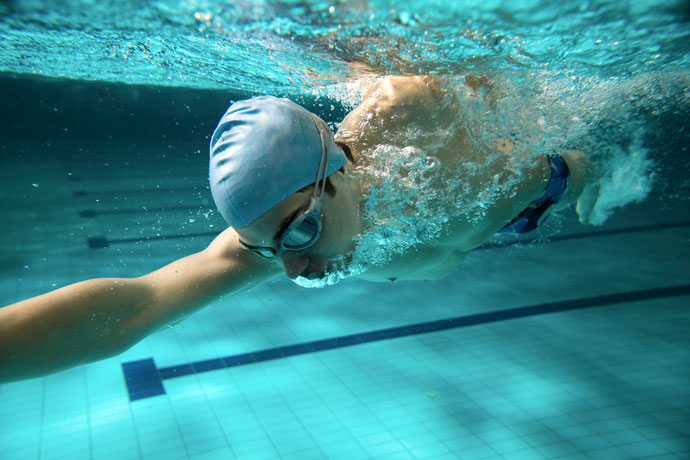
With goggles, get in the shallow end of the pool. Hold your breath and lean forward, putting your face in the water. (NO nose plugging.) Once under, slowly exhale all of the air in your lungs (mouth, nose, or both) then turn your head to the side, taking one slow relaxed breath in, then put your face back in the water and exhale fully into the water. Each breath should take about five seconds, and you should be controlled and relaxed. If any feelings of anxiety arise, stop and gather yourself and just slow your breathing down out of the water before trying again. Be patient with yourself if this seems difficult.
Tip #4 Try it using a kickboard!
Moving forward, you can begin to practice this breathing technique while using a kickboard. Hold the bottom edge of the kickboard so that there is a space in between your arms for you to put your face in. Push off the wall, with face in and begin kicking. Exhale fully and controlled, then turn head to side to inhale. (Do not lift to the front! Develop good head position techniques early on. No lifting!) Get a full quick inhalation, then face back in, blow bubbles.
Practice these techniques until your breathing becomes easy and relaxed. There should be no stiffness in the neck or face. If you can develop this ease of breath in the very beginning it will facilitate a much quicker learning process when moving forward into the mechanics of the strokes.
Wrapping Up
Summing this all up, I can’t stress enough the importance of being able to breath in a relaxed and rhythmic fashion when swimming. Don’t try to muscle your way through a swim workout without learning proper technique in the very beginning. If poor breathing technique exists, the rest of the stroke is going to suffer, progress will be hard to come by, and the potential for injury becomes much higher.
Set yourself up for success!
Stay tuned for more tips from:
Lane Martin
Fast Lane Swimming
“Swim Like You Mean It!”